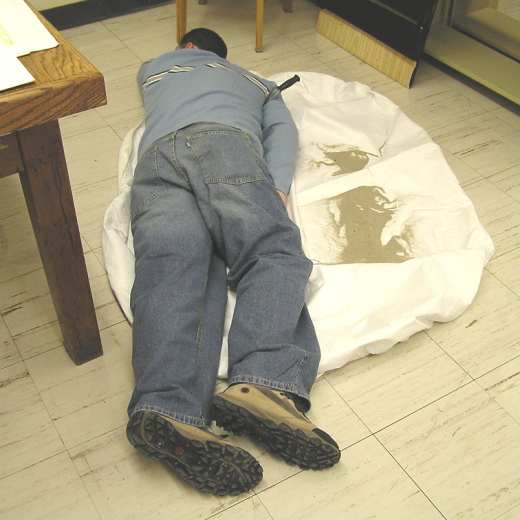
Catoctin/Fauquier contact

Catoctin/Fauquier contact
Power washing a quarry block near Aldie, VA that preserves a soft sediment contact of the Fauquier Formation cap carbonate and pillow basalt of the Catoctin Formation.

Thursday, February 9, 2012

Hidden Secrets in Tiny Niches: From Jurassic Park to Fluid Inclusions.


People that have seen the science-fiction film Jurassic Park must still remember that in the film, the eccentric billionaire created a theme park populated with dinosaurs cloned from the DNA extracted from mosquitoes preserved in prehistoric amber(Fig. 1 )
Fig.1. In the science-fiction film Jurassic Park, scientists  extracted the dinosaur DNA from prehistoric amber, and then cloned dinosaurs in modern world.


Similar with extracting the dinosaur DNA from amber, geologist find out they can also extracting the paleotemperature from fluid inclusions(Fig. 2 ) preserved in the precipitated mineral crystals!
Fig. 2 These are fluid inclusions in calcite crystals in Tarim basin, NW China. The paleogeofluid was trapped in the crystals ,thus provides geologists a great opportunity to extract temperature information from them.

In the remote NW China, petroleum geologist found intense paleogeofluid activities in the old rocks. To figue out the paleotemperature of these fluid flows is significant to the petroleum exploration there.
Fig.3 The measuring process of melting and homogenization temperatures of fluid inclusions. The measured homogenization temperature represents the simultaneous temperature of the fluids at that time. With the measured melting temperatures we can calculate the salinity of the fluids.

Using the cooling and heating stage, we first freeze the fluid inclusions into a supercooled status, and then slowly warm them until the gas bubble in the  fluid inclusions disappear. At that time, the gas and the liquid phases homogenize into one phase. The temperature of this disappearing point is just the very paleotemperature of these fluid flows that traped in the  fluid inclusions (Fig.3). Finally, we geologists succeed to get the temperature information! With this important information, it will be easier for the petroleum geologists to find out more oil!

Chemical differentiation of the silicate earth: insights from the distribution of the element Eu


    The formation of the Earth’s continental crust is one of the main outcomes of planetary differentiation. The composition of the crust provides insights into how the crust formed. It’s been generally agreed that the Earth continental crust was extracted from the mantle billions of years ago. During these processes, incompatible elements were removed from the mantle and preferentially partitioned into the continental crust, leaving the residual mantle depleted. Thus the knowledge of elemental distribution and fractionation may improve our understanding of the Earth differentiation and evolution.

Fig. 1 Cross section of the Earth. The layered structure of the Earth results from a series of physical and chemical differentiation.

    REE (rare earth element) is a group of elements that behave quite similarly to each other. Significant REE fractionation only occurs under certain circumstances. The REE abundance pattern is thus very useful to indicate geological processes. Contrary to all other REEs, which are trivalent elements (except Ce4+), Eu is unique in that it can also exist in the reduced (2+) valence state under reducing conditions. This feature, therefore, makes Eu easily fractionated from other REEs during Earth chemical differentiation, as divalent Eu is generally more compatible than other trivalent REEs, and may be stuck in the depleted mantle.
    The REE abundance pattern of the upper continental crust has, on average, a negative Eu anomaly (Eu is depleted relative to its neighboring rare earth elements). Some models for the composition of the bulk continental crust also indicate a negative Eu anomaly. However, to precisely constrain the Eu abundance relative to other REEs has often proved formidable by crustal sampling alone. Assume the bulk Silicate Earth (SE) has no Eu anomaly, that is, Eu anomaly is absent in the combination of the continental crust and depleted mantle. The depleted upper mantle, as a chemically complementary reservoir to the continental crust, provides a potential approach to unraveling this issue. Huge amount of basaltic magma erupts along the mid-ocean ridges–spreading centers of plate tectonics. These basalts are known as mid-ocean ridge basalts (MORBs), which came directly from the depleted mantle. MORBs thus open the window for studying the depleted mantle. My study will focus on MORB glasses from the Atlantic Ocean, Pacific Ocean and Indian Ocean, and examine whether the depleted mantle holds excessive Eu.

Fig. 2 Sampling locations of my research cover the mid-ocean ridges of the Pacific Ocean, Atlantic Ocean and Indian Ocean.

Tuesday, February 7, 2012

Walk a Mile in My Shoes -The Life of a Forensic Geologist


"Every contact leaves a trace." This is the mantra repeated by forensic geologists around the globe and was first postulated by 20th century scientist Edmond Locard, director of the first crime laboratory in Lyon, France. Trace evidence is any type of material left at or taken from a crime scene, or the result of contact between two objects, such as shoes and the floor or soil.

Figure 1: Forensic geologists deal with many mediums including shoes, bags of sediment, clothing, and rocks & minerals.

Forensic geology applies geological principles and analytical techniques to aid in solving criminal and legal investigations. It was first introduced to popular culture by Arthur Conan Doyle in the Sherlock Holmes novels, where Holmes was able to identify where a suspected individual had been based on the composition of clay on the bottom of his shoes.


Although seemingly unfamiliar to most people, forensic geology is largely prevalent in the news. Recent examples include Forensic Geologist Maureen Bottrell testifying at the Casey Anthony trial. Bottrell analyzed soil material found in the trunk of Anthony's car as well as several pairs of Anthony's shoes to determine whether a link could be made between the collected sediment and possible burial site of the deceased toddler, Caylee. Other local examples include a recent string of robberies and murders over expensive shoes in the D.C. metro area.

Figure 2: This demonstrative scene shows the many sources of evidence available at a crime scene, including material attached to the bottom of a victim's shoes.

My research follows the recent crime in our area. I will be taking several pairs of shoes, of varying tread size, and walk around selected areas; I am interested in observing the characteristics of the material that is transferred from the scene of interest to the footwear. These transferred sediments will then be compared with bulk soil samples from the area to determine if and how material is preferentially transferred based on shoe tread size. The aim of my research is to increase the efficiency and accuracy of trace evidence analysis with respect to geological materials. I am focusing on using cost-effective, practical analyses that may readily be used in laboratories across the world.

Thursday, February 2, 2012

A Late Triassic Faunal Transition and Associated Events

Figure 1. Chinle Formation stratigraphy in southern Petrified Forest National Park with approximate ages. (Adapted from a figure by Jeff Martz)

Recent revisions in the stratigraphy of the Chinle Formation along with more precise documentation of vertebrate fossil occurrences have revealed a distinct faunal transition, which coincides with several other biologic and geologic events. The Chinle Formation is exposed throughout northern Arizona, southern Utah, southwestern Colorado, and northwestern New Mexico and represents river deposits from the Late Triassic.  Although the event was first identified in Petrified Forest National Park (PEFO), it can be identified throughout the Chinle. It has not yet been identified outside of the southwestern United States. Lithologically, the transition is represented by a layer of bright red, petrified "mulch", known as the "persistent red silcrete zone" (PRSZ). This layer occurs only a few meters above the base of the Jim Camp Wash beds in the Sonsela Member of the Chinle Formation. It is most easily observed in the southern half of PEFO, where the Sonsela Member is widely exposed.

Figure 2. The persistent red silcrete zone in the Jim Camp Wash beds near the Painted Desert Museum of Petrified Forest National Park. (Photo by Susan Drymala)

The transition divides two distinct biostratigraphic units (biozones), defined by phytosaur taxa, with 'Leptosuchus' only occurring below the turnover level (defining the Adamanian biozone) and Pseudopalatus only occurring above (defining the Revueltian biozone). As large, robust, river dwelling animals, phytosaurs were easily preserved in the fossil record, especially their squamosals (large, knob-shaped bones at the back of the skull, useful in identifying species). Aetosaurs also show a distinct turnover at the Adamanian-Revueltian boundary and are represented by abundant fossils (primarily their armor plates - a.k.a. osteoderms - which are also useful in species identification). Although there are many species of aetosaurs present throughout the Chinle Formation Calyptosuchus and Typothorax can be used to identify the Adamanian and Revueltian, respectively. The boundary can be identified through patterns in other vertebrates as well, but phytosaurs and aetosaurs are the most densely sampled, especially at stratigraphic intervals directly above and below the transition zone, suggesting that the turnover represents a real event rather than an affect of sampling bias.

Figure 3. Phytosaur (left) and aetosaur (right) taxa representative of the two biozones. (Adapted from an image by Jeff Martz)
Although the Adamanian-Revueltian was first observed in vertebrate fossils, several other transitions have now been identified. Lithology and isotope records suggest a steady drying of the climate over this period, which may be due to the slow movement of the North American continent northward, away from the equatorial zone. The Revueltian shows an increase in well-developed paleosols and pedogenic carbonate nodules, compared to the Adamanian. This coincides with the appearance of large beds of unionid bivalves (known today as river mussels) which are known to prefer relatively alkaline waters. These beds only appear above the PRSZ of the Jim Camp Wash beds. A turnover in flora has also been identified, represented by the transition from Pollen Zone II to Pollen Zone III. Current absolute ages (U-Pb ages from detrital zircons) for Chinle strata place the persistent red silcrete zone and the Adamanian- Revueltian boundary between about 218 (lower Rainbow Forest Bed) and 214 Ma (middle Jim Camp wash beds). A cause for the event has not yet been identified, but some possibilities exist. Interestingly, the Manicouagan bolide impact in Quebec, Canada occurred at 215.5 Ma, although it currently cannot be directly tied to the Adamanian-Revueltian turnover.

_______________________________
Martz, J. W. & W. G. Parker. 2010. "Revised lithostratigraphy of the Sonsela Member (Chinle Formation, Upper Triassic) in the southern part of Petrified Forest National Park, Arizona." PLoS ONE 5 (2)

Parker, W. G. & J. W. Martz. 2011. "The Late Triassic (Norian) Adamanian-Revueltian tetrapod faunal transition in the Chinle Formation of Petrified Forest National Park, Arizona." Earth and Environmental Science Transactions of the Royal Society of Edinburgh 101: 231-260

Ramezani, J., S. A. Bowring, M. S. Pringle, F. D. Winslow, & E. T. Rasbury. 2005. "The Manicouagan impact melt rock: a proposed standard for the intercalibration of U–Pb and 40Ar/39Ar isotopic systems." Geochimica et Cosmochimica Acta 69

Ramezani, J., G. D. Hoke, D. E. Fastovsky, S. A. Bowring, F. Therrien, S. I. Dworkin, S. C. Atchley, & L. C. Nordt. 2011. "High-precision U-Pb zircon geochronology of the Late Triassic Chinle Formation, Petrified Forest National Park (Arizona, USA): Temporal constraints on the early evolution of dinosaurs." Geological Society of America Bulletin

Stream Restoration: Helpful or Harmful?


Many of you may have noticed the large scale stream restoration that is occurring in Paint Branch Creek on the backside of campus (Figure 1). A restoration is defined as returning the stream to a close approximation of its pre-disturbed condition. When I see a restoration of this magnitude I wonder is this helping or causing more harm to the stream? Rivers and streams in the United States provide crucial ecosystem services to humans; however our alterations of the natural landscape have become a major threat to stream water quality.  According to a water quality inventory done in 2000 by the Environmental Protection Agency, approximately one-third of U.S. rivers and streams are considered impaired or polluted. Due to this extensive degradation, billions are spent annually on stream restoration efforts.

Figure 1. Restoration efforts in Paint Branch Creek above campus (McDowell, 2012).
The stream restoration occurring off campus appears to involve changing the shape of the stream banks and then anchoring them into place with large boulders. The goal of this type of restoration project is to stabilize the banks to reduce the amount of sediment eroded into the stream environment. Sediment is considered to be one of the major problems effecting water quality in the United States, it can clog streams, limit light reaching stream organisms, and carry toxic pollutants. In this area, our streams drain into the Chesapeake Bay which has problems with excessive suspended sediment (sediment in the water column). This restoration is of importance to me because my master's thesis will involve looking at the suspended sediment in the NE Branch of the Anacostia and Paint Branch in order to determine if this type of restoration is even necessary. I plan to examine the system to see how much sediment is actually being transported and what areas of the stream are acting as sources and sinks for sediment. Another goal of anchoring the banks in a stream restoration is to prevent lateral migration, or movement of the stream left and right, this is important in streams like Paint Branch where construction has occurred so close to the stream. Some parking lots along route 1 had even begun to fall into the stream before the restoration began.


Figure 2. The sediment line showing the merging of Paint Branch Creek and Indian Creek to form the NE Branch of the Anacostia (McDowell, 2012).
You may be wondering how something that stabilizes the banks from erosion and prevents parking lots and building from falling into a stream could be considered anything but good, however I have two main concerns about this particular stream restoration. My first major concern has to do with the anchoring of the banks using large boulders. This process can cause a disconnect between the stream system and its floodplain, which is the land adjacent to the stream that can experience flooding during a storm event. This disconnect occurs due to the direct application of the boulders and because of stream incision, or deepening, which is a byproduct of the inability to migrate left and right. The connection between a stream channel and its floodplain is important because it allows the surface water in the stream to interact with the groundwater in the floodplain. This can facilitate filtration or sediment and toxic substances from the stream improving the overall water quality.
The other concern I have with this project is that while the goal may be to reduce long term bank erosion in the short run large amounts of sediment are being disturbed and transported downstream (Figure 2). This sediment will not only affect Paint Branch Creek but also the North East Branch of the Anacostia, the mainstem of the Anacostia, and possibly even the Chesapeake Bay. At this time of year excess sediment can be especially problematic due to the fact that the ground is already so wet there is no room to store water, which normally would allow suspended sediment to settle out. It is by no means my job to judge the restoration effort taking place on Paint Branch Creek and in reality it is too soon to make a final judgement anyways. However, I wanted to point out the concerns I had about the project and why it is important to make sure a restoration is actually meeting its goals. Is this stream restoration helping the stream or harming it, I will leave that for you to decide.

Allan, J. D. "LANDSCAPES AND RIVERSCAPES: The Influence of Land Use on Stream Ecosystems." Annual Review of Ecology, Evolution, and Systematics 35.1 (2004): 257-84.

Bernhardt, E. S., M. A. Palmer, J. D. Allan, G. Alexander, K. Barnes, S. Brooks, J. Carr, S. Clayton, C. Dahm, J. Follstad-Shah, D. Galat, S. Gloss, P. Goodwin, D. Hart, B. Hassett, R. Jenkinson, S. Katz, G. M. Kondolf, P. S. Lake, R. Lave, J. L. Meyer, T. K. O'Donnell, L. Pagano, B. Powell, and E. Sudduth. "ECOLOGY: Synthesizing U.S. River Restoration Efforts." Science 308.5722 (2005): 636-37.

Craig, L.S., M.A. Palmer, D.C. Richardson, S. Filoso, E.S. Bernhardt, B.P. Bledsoe, M.W. Doyle, P.M. Groffman, B.A. Hassett, S.S. Kaushal, P.M. Mayer, S.M. Smith, P.R. Wilcock. 2008. Stream Restoration Strategies for Reducing River Nitrogen Loads. Frontiers in Ecology and the Environment, v. 6.

Explosive Science: a Sexy New Answer to Climate Change

      
            What can rock deformation do for you?  Maybe turn your car exhaust into limestone!
            Climate change is one of the most talked about issues of the last two and a half decades.  Though its existence is now generally accepted, debates about its causes, extent and what’s to be done continue to rage; however, it has become clear that one major cause of climate change is increased levels of carbon dioxide gas in the atmosphere.  Diverse solutions have been proposed, from massive reforestation efforts to iron-seeding the oceans to stimulate algal blooms, all of which have encountered resistance from various environmental and/or industrial groups.
Industrial processes release carbon dioxide and other byproducts into the atmosphere.


One of the proposed technologies that has emerged at the front of the pack is geological carbon sequestration, or the practice of pumping carbon dioxide into the ground to remove it from the atmosphere.  This technology generally assumes two forms, reservoir sequestration and mineralization.
Reservoir sequestration involves storing carbon dioxide as a gas trapped in non-economic coal seams or dissolved in non-potable aquifers.  This method is popular because it is essentially already in use by the hydrocarbon drilling industry in the form of enhanced oil recovery.  Several notable drawbacks include contamination of potable aquifers, acidification of groundwater and concomitant changes in the mechanical behavior of reservoir rocks and catastrophic degassing and asphyxiation.
Mineralization takes advantage of natural reactions of minerals from deep within the earth with carbon dioxide in the atmosphere to form stable carbonate rocks.  The main benefit of this method is that it is safe.  The carbon dioxide gets stored as stable carbonate rocks, and is therefore relatively static.  The drawbacks of this method are mostly cost related.
Carbonate minerals precipitated in old mantle rock.
The reaction of deep minerals and carbon dioxide happens spontaneously, but slowly on human time scales.  To speed up the reaction, the materials must be ground to increase the amount of material exposed to carbon dioxide and heated to speed up the reaction.  Mining, transporting, and heat treating the rocks then manufacturing filters to put on smokestacks world-wide would be too energy intensive to make a real impact on carbon emissions.


However, there may be another way.


The reaction of carbon dioxide with mafic minerals actually releases energy in the form of heat, so once initiated the reaction can be self-sustaining.  The reaction also has a positive change in volume.  A runaway positive volume change reaction in a confined space is usually referred to by another name: a bomb.  If we can harness this power of this natural bomb to fracture the rocks, creating pathways for fluid flow and exposing fresh reactive material, we could maintain a self-heating, self-pulverizing in-situ carbon dump.  BAM!
           In our lab, we have been designing an apparatus to run carbon dioxide-rich fluids through reactive materials during active deformation and monitor the changes in mechanical and transport property behavior.  We plan to test different pressure and temperature regimes to see if we can constrain under which conditions this reaction driven cracking might take place.  This is still a new area of research, so there is much to learn.  The myriad possibilities make it truly exciting science!

First image from the Library of Congress.
Second image from http://cain.ice.ucdavis.edu/repository/SerpWebSoilPics.htm 

Shale Reservoirs - Natural Gas Generation & Extraction


Shale is a fine-grained, laminated sedimentary rock composed of clay- and silt-sized sediments typically deposited in low-energy environments, along with algal-, plant- and animal-derived organic matter.  Formation of natural gas within shale primarily occurs via thermogenic degradation (cracking) of organic material (kerogen) through time, although biogenic production can also occur.  As the organic-rich shale rocks are buried and subjected to increasing pressures and temperatures (at a typical geothermal gradient of 30oC/km), breakdown of organic matter to petroleum hydrocarbons begins to occur.  The oil generation window occurs at approximately 60-120oC (2-4km depth), while the gas generation window occurs at 100-200+oC (3-6km depth).  The thermal maturity of the shale rock, generally measured by vitrinite reflectance (%Ro), is thus used to determine the type and quantity of hydrocarbons present.  Vintrinite, composed of cellulose and lignin, is a common organic constituent in coal and woody kerogen that has a vitreous luster and characteristic reflectance when heated.  Gas-generating shale rock has typical % Ro values ranging from 1.5-3.0%, where as oil generation predominantly occurs in sources rocks with a <1.5% Ro.


          Figure 1. Summary of the oil and gas formation process.

In addition to the thermal maturity of the source rock, the volume of produced gas is also dependent on the source of the organic matter and overall TOC content.  Kerogen is the insoluble portion of organic matter that is not extractable using organic solvents (versus bitumen).  There are four main types of kerogen, differentiated by their composition.  Type III, composed of woody terrestrial source material, is typically known to generate gas.  Globally averaged organic contents of shale are estimated to range between 2-10% carbonaceous material, with higher percentages being indicative of deposition under anoxic, reducing environments.  In general, the higher the TOC content within shale, the higher the probability of finding economically viable quantities of gas.
Once generated, natural gases are stored in natural fractures and pores between individual shale grains, and are also adsorbed onto the surfaces of, and also pores within, kerogen and clay particles.  Due to shale’s extremely low porosity and matrix permeability (< 1 millidarcy, mD), the organic-rich “black shales” can serve as both source rock and reservoir, trapping large estimated quantities of natural gas. 


                             Figure 2. Conventional and unconventional petroleum reservoirs.

 It is also this characteristic of shale structure that makes extraction of gas difficult and uneconomical, and thus why shale has been historically viewed as an “unconventional” gas resource.  However, current technological advances in horizontal drilling and fracture stimulation technology (ie: hydraulic fracturing) have enhanced access to natural fractures within shale and successfully increased matrix permeability, allowing the extraction of shale gas to become more economically viable energy.
Numerous questions and concerns are arising regarding the environmental effects of such drilling and extraction practices, with particular concern of the fluids used in hydraulic fracturing.  What is the exact composition of the “hydrofrack” fluids? What are the geochemical reactions of the fluids interacting with the shale?  What will happen to the integrity of the shale reservoir and surrounding rock formations over time?  While residual fluids left in the shale reservoir become trapped within fractures and pore spaces, ultimately inhibiting further natural gas generation or extraction over time?
My work ultimately aims to determine the chemical and physical interactions of different types of fracking fluids (water-based vs. CO2-based) on shale rock formations of varying TOC and carbonate contents, thermal maturity and brittleness index, and thus determine their impact on gas recovery efficiency.  A more complete and quantitative understanding of the impacts of hydraulic fracturing fluids in shale reservoirs is imperative if we are to continue to depend on natural gas as a major energy resource.


References:

Arthur, J.Daniel, Bohm, Brian, and Layne, Mark, 2008.  Hydraulic Fracturing Considerations for Natural Gas Wells of the Marcellus Shale.Ground Water Protection Council Annual Forum.

U.S. Department of Energy (DOE), Office of Fossil Energy and National Energy Technology Laboratory, 2009.  Modern Shale Gas Development in the United States: A Primer.  DE-FG26-04NT15455.3-5.