
 |
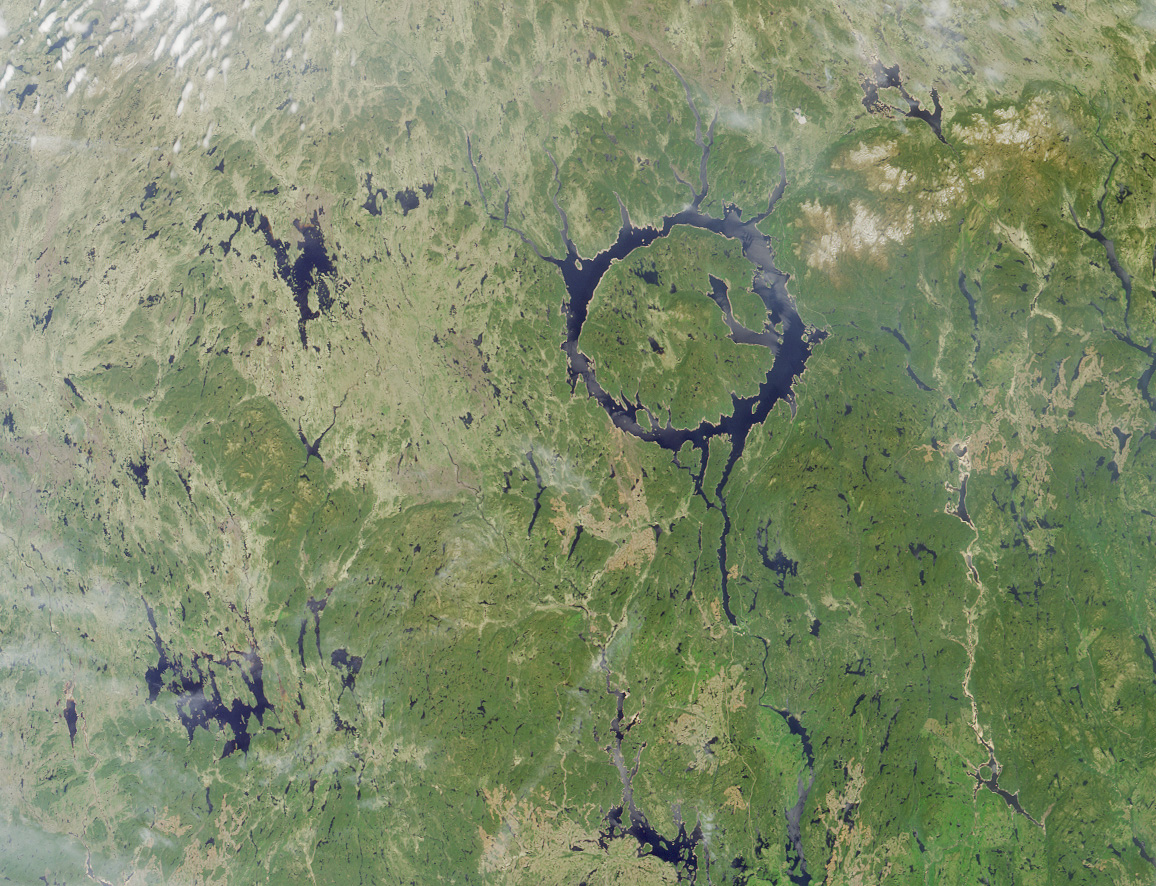
| Figure 1. Satellite image of the Manicouagan crater. Today, it forms a circular lake, 70 km in diameter, in northeaster Quebec, Canada. (Image by NASA) |
The Chinle Formation is exposed throughout northern Arizona, southern Utah, southwestern Colorado, and northwestern New Mexico and represents river deposits from the Late Triassic. Scientists have been studying the rocks and fossils of the Chinle for over a century, especially in Petrified Forest National Park, but it was only in the last few years that the stratigraphy (the order in which rocks were deposited) was properly worked out. Once these rock layers were placed in the proper order, an interesting pattern developed. It was noticed that certain fossils only appeared in the upper part of the Chinle (younger rocks) while completely different fossils appeared in the lower part (older rocks) and that these two groups of fossils (called "faunas") were separated by a distinct, and geologically abrupt, layer. This layer, and therefore the transition between the two faunas, is represented by a thin layer (about 10 cm) of bright red, petrified "mulch". Geologists call this silcrete, because it is very hard, like concrete, and made up almost entirely of the mineral silicate. It occurs in a group of rocks called the Sonsela Member, which can be easily seen throughout the southern half of Petrified Forest.
 | |||||||||||||||||||||||||||||||||||||||||||||||||||||||||||||||||||
| Figure 2. The red silcrete cascades down the sides of rocky knolls as erosion wears away the underlying rock. |
 |
| Figure 3. Phytosaurs (left) and aetosaurs (right) that represent the two faunas. The older (Adamanian) species are distinctly larger than their younger (Revueltian) counterparts. (Adapted from an image by Jeff Martz) |
 |
| Figure 4. Chinle stratigraphy with ages, showing the mulch layer in red (Adapted from a figure by Jeff Martz) |
Once this pattern in the fossils was discovered, geologists and paleontologists started noticing other patterns. The rocks showed evidence of a steady increase in dry conditions, through changes in their chemical record and changes in the types of rocks. After the red silcrete layer, large beds of river mussels start to appear, most likely due to an increase in the alkalinity of the water. Changes in flora are also observed through a transition in the types of pollen found. And finally geologists have started to place absolute dates are several layers of the Chinle Formation due to the presence of a mineral called zircon. These dates place the red mulch layer and the turnover event between about 218 and 213 million years ago. This fits perfectly with the age of the Manicouagan impact at 215.5 Ma.
So, did the Manicouagan cause the change in fauna? the drying climate? Much more research still needs to be done before it can be said for certain. What other animals can we see this abrupt transition in? Did this event affect land predators like it affected the phytosaurs and aetosaurs? Can this even be seen else where in the United States? These are questions I plan to answer.
_______________________________
Martz, J. W. & W. G. Parker. 2010. "Revised lithostratigraphy of the Sonsela Member (Chinle Formation, Upper Triassic) in the southern part of Petrified Forest National Park, Arizona." PLoS ONE 5 (2)
Parker, W. G. & J. W. Martz. 2011. "The Late Triassic (Norian) Adamanian-Revueltian tetrapod faunal transition in the Chinle Formation of Petrified Forest National Park, Arizona." Earth and Environmental Science Transactions of the Royal Society of Edinburgh 101: 231-260
Ramezani, J., S. A. Bowring, M. S. Pringle, F. D. Winslow, & E. T. Rasbury. 2005. "The Manicouagan impact melt rock: a proposed standard for the intercalibration of U–Pb and 40Ar/39Ar isotopic systems." Geochimica et Cosmochimica Acta 69
Ramezani, J., G. D. Hoke, D. E. Fastovsky, S. A. Bowring, F. Therrien, S. I. Dworkin, S. C. Atchley, & L. C. Nordt. 2011. "High-precision U-Pb zircon geochronology of the Late Triassic Chinle Formation, Petrified Forest National Park (Arizona, USA): Temporal constraints on the early evolution of dinosaurs." Geological Society of America Bulletin

No comments:
Post a Comment